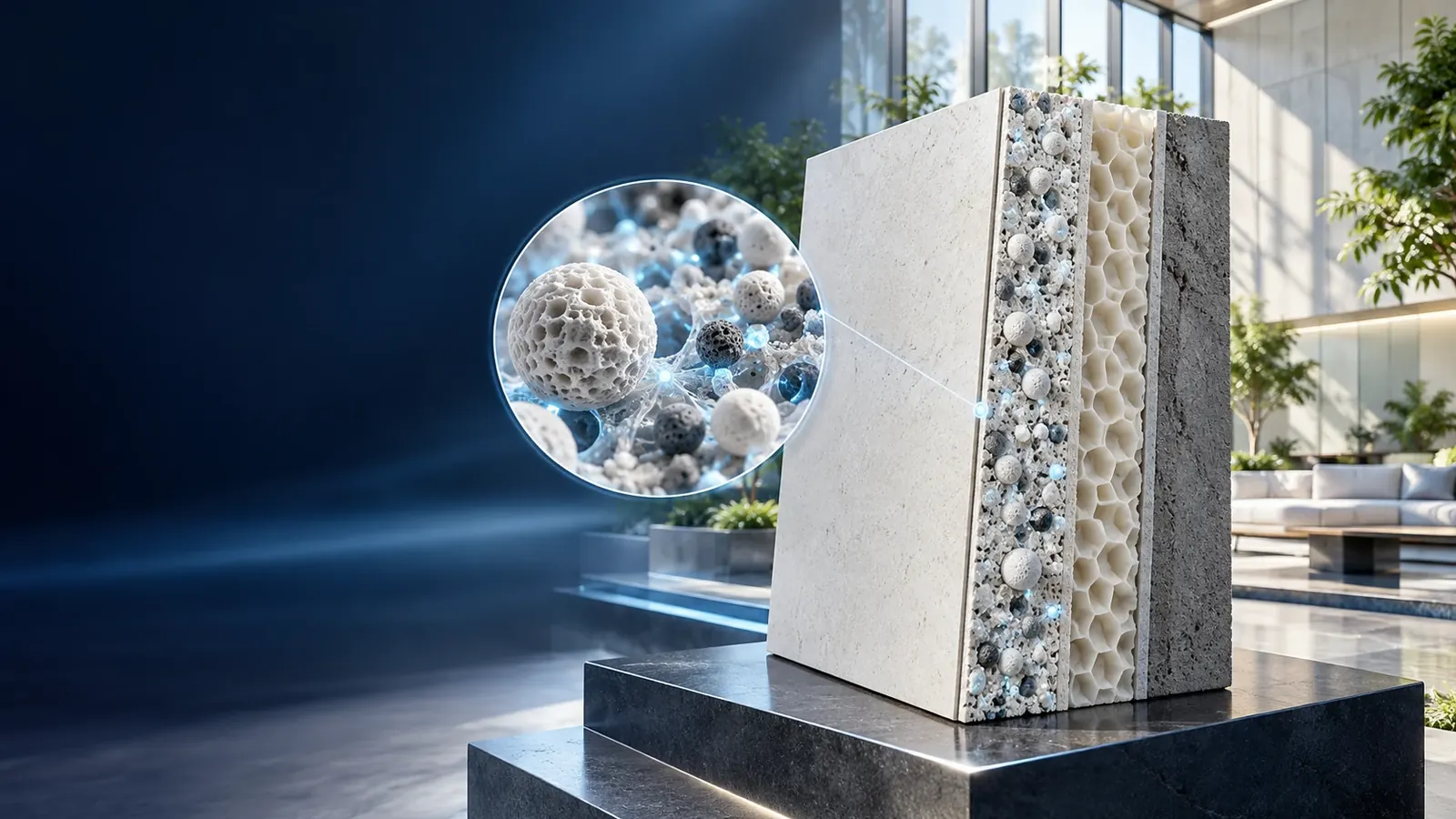
Illustration of functional composite building panels with embedded mineral constituents

Illustrative image

Research, Development and Industrialisation

Eco-Functional Material Constituents and Composite Building Materials

From Functional Material Design to Sustainable Building Applications

We research and develop eco-functional material constituents and their integration into composite building materials, with a focus on environmental compatibility, multifunctional performance and resource efficiency.

Our work begins with functional micro-aggregates, mineral materials and composite interfaces. We investigate how air purification, humidity regulation, thermal management, fire resistance and electromagnetic protection can be incorporated into building products, supporting the development of sustainable materials with enhanced functionality.

Focus areas

In this programme

  • Functional micro-aggregates
  • Purification and self-cleaning
  • Humidity regulation
  • Thermal management
  • Electromagnetic shielding
  • Flame retardancy
  • Radon barriers
01 / Constituents

Functional Constituent Design

Eco-functional constituents are the basic components that impart specific functions to composite building materials. They may take the form of micro-aggregates, particles, fibres, powders or surface-modified additives.

We investigate how composition, pore structure, surface properties and interfacial interactions influence responses to light, heat, electrical and magnetic fields, and changes in temperature and humidity. This provides a basis for connecting microscopic material design with performance in use.

  • Selection, processing and functionalisation of natural minerals
  • Preparation and surface modification of functional micro-aggregates
  • Control of porous structures and active adsorption sites
  • Dispersion, immobilisation and stability of functional components
  • Interactions between constituents and the integration of complementary functions
02 / Priorities

Research Priorities

Environmental Purification and Self-Cleaning Materials

We investigate adsorptive, photocatalytic and combined purification constituents for integration into wall coatings, decorative panels, ceramics and porous building materials.

Evaluation focuses on pollutant removal performance, operating conditions, adsorption saturation, regeneration potential, reaction by-products and long-term functional stability.

Antimicrobial, Mould-Resistant and Odour-Control Materials

Through the design of functional minerals, active components and carrier structures, we investigate materials intended to limit microbial attachment, inhibit mould growth and control odours.

Key considerations include the immobilisation and release of active components, resistance to cleaning, service life and environmental safety. Potential applications include kitchens, bathrooms, public buildings and humid environments.

Humidity-Regulating Materials

We explore the moisture absorption, storage and release properties of porous minerals and composites to develop wall materials, finishes and panels capable of passive humidity regulation.

Research addresses pore size distribution, moisture exchange rates, cyclic stability and compatibility with the host material, while maintaining dimensional stability and resistance to mould.

Thermal Insulation and Heat Management

We investigate lightweight porous constituents, low-conductivity fillers, phase-change components and materials with tailored infrared properties for building energy applications.

Our work explores combinations of insulation, heat storage and temperature regulation, with particular attention to thermal conductivity, thermal cycling stability, fire performance and structural durability.

Electromagnetic Shielding and Microwave Absorption

We research conductive, dielectric and magnetic constituents for electromagnetic shielding and absorption in building panels, coatings and enclosure components.

Material composition, filler distribution, layered structures and interfaces are tailored to the intended frequency range, while considering weight, installation requirements and durability.

Flame Retardancy and Building Safety

We develop inorganic flame-retardant constituents and composite formulations for polymer coatings, decorative materials and building panels.

Evaluation considers flame-retardant performance, smoke emissions, mechanical properties and performance retention after ageing.

Radon Barriers and Specialised Protective Materials

For specific building environments, we investigate low-permeability matrices, adsorptive constituents and multilayer structures for controlling radon migration and providing specialised protection.

Each application is assessed against its intended protective function, with attention to intrinsic material radioactivity, barrier performance, joint sealing and long-term stability.

Biomimetic and Environment-Responsive Materials

Drawing on the multiscale structures and interfaces found in natural materials, we investigate self-cleaning, self-healing and temperature- or humidity-responsive systems.

We also explore the physical properties and integration of ion-releasing and far-infrared-emitting constituents, using measurable material performance and safety in use as the basis for evaluation.

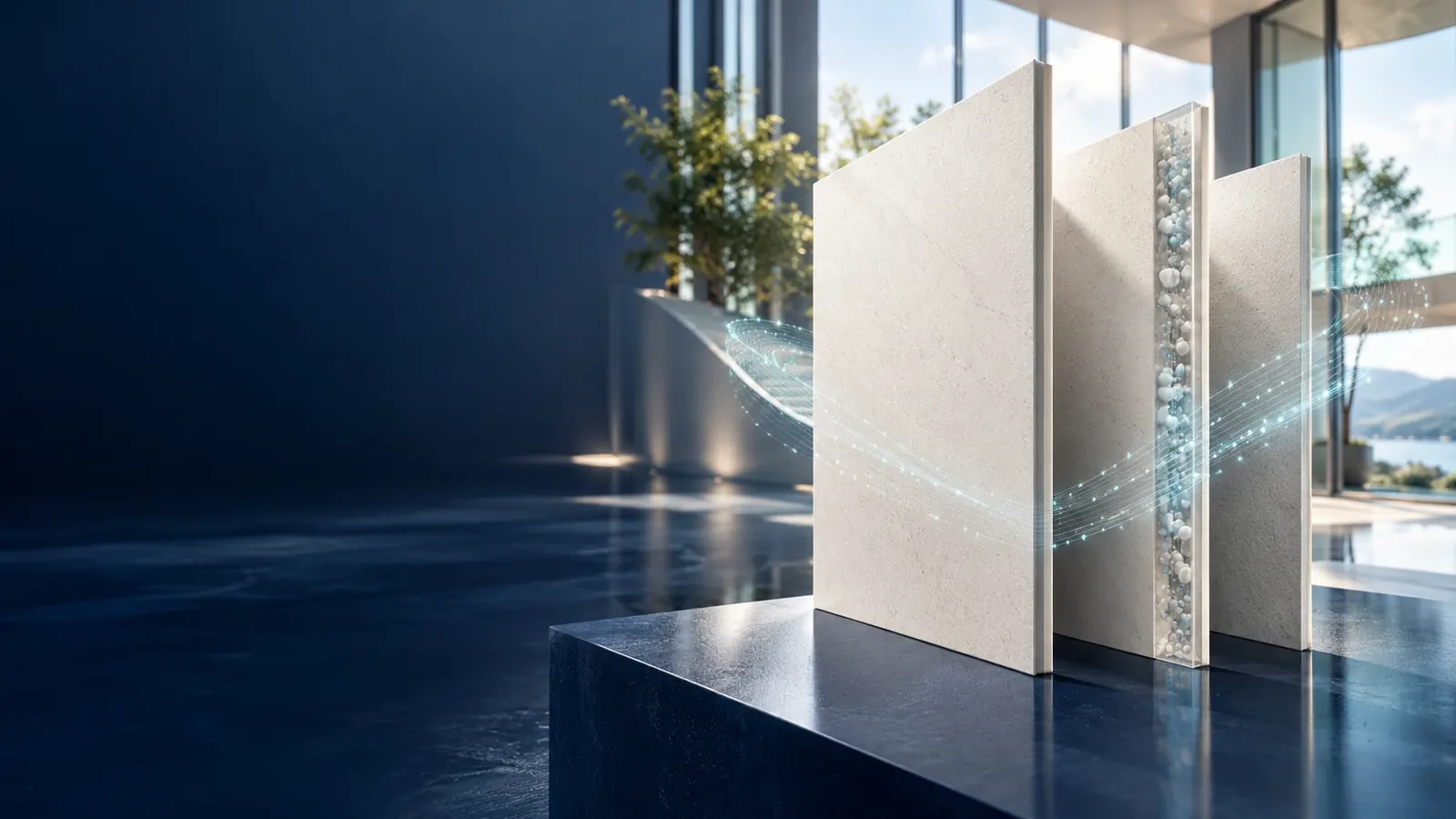
Illustration of a layered composite wall panel with porous functional constituents
Functional micro-aggregates and porous mineral constituents are integrated into layered building components.
03 / Integration

Composite Material Integration

01

Constituent–Matrix Compatibility

We investigate interactions between functional constituents and cement, gypsum, ceramic, glass and polymer matrices, optimising interfacial adhesion, dispersion and processing stability.

02

Multifunctional Design

Purification, humidity regulation, insulation, flame retardancy and protective functions are combined according to application requirements.

We assess both beneficial interactions and potential conflicts between components to preserve strength, durability and workability.

03

Functional Layers and Integrated Components

Research covers coating, impregnation, blending, layered construction and bulk forming processes to incorporate functional constituents into finishes, panels, blocks and other building components.

04

Functional Durability and Maintenance

We evaluate the effects of cleaning, abrasion, temperature and humidity cycling, and prolonged exposure on functional performance.

Where appropriate, we investigate regeneration, surface renewal and maintenance methods.

04 / Applications

Industrial Applications

We develop material and component solutions suited to manufacturing, installation and maintenance across a range of building applications.

Interior finishes

Functional wall coatings, decorative mortars, wall panels and ceiling materials.

Kitchens, bathrooms and public spaces

Antimicrobial, mould-resistant, odour-control and cleanable finishes.

Building envelopes

Composite panels for insulation, humidity regulation and heat storage.

Ceramic and mineral products

Functional ceramics, mineral-based panels and porous components.

Special-purpose spaces

Electromagnetic shielding, absorption and radon barrier materials.

Building refurbishment

Functional surface upgrades and energy-efficiency improvements.

05 / Pathway

Validation and Industrialisation

Development begins with defined user requirements and progresses through constituent selection, composite design, process development and application validation.

  1. 01

    Application Requirements

  2. 02

    Constituent Design

  3. 03

    Composite Integration

  4. 04

    Performance and Safety Assessment

  5. 05

    Pilot Production

  6. 06

    Demonstration Projects

  7. 07

    Long-Term Monitoring and Industrial Deployment

Key evaluation areas include

  • Functional performance under realistic operating conditions
  • Mechanical properties, adhesion and dimensional stability
  • Functional durability and batch consistency
  • Substance emissions, leaching and intrinsic material radioactivity
  • Manufacturing, installation and maintenance requirements
  • Resource consumption, recyclability and whole-life costs
06 / Collaboration

Industrial Collaboration

We welcome collaboration with mineral suppliers, functional additive developers, building material manufacturers, architectural practices, construction companies and research institutions.

Who we work with
  • Mineral suppliers
  • Functional additive developers
  • Building material manufacturers
  • Architectural practices
  • Construction companies
  • Research institutions
Areas of cooperation
  • Functional constituent development
  • Enhancement of conventional building materials
  • Formulation and manufacturing optimisation
  • Product testing
  • Pilot validation and industrialisation projects

Contact Us

Integrating Material Functionality into Buildings

Share your intended application, host material, target functions, production conditions and performance requirements with us to explore opportunities for research, validation and industrial application.