Illustration of functional ceramic components including a ferrite ring and a sensor chip

Illustrative image

Research, Development and Industrialisation

Advanced Functional Ceramics and Device Integration

Engineering Microstructure to Deliver Functional Performance

We research advanced functional ceramics for electrical, thermal, magnetic, optical and environmental sensing applications. Our work examines how composition, crystal structure, grain boundaries and interfaces determine material performance.

By integrating powder engineering, precision forming, controlled sintering and thin- and thick-film processing, we develop pathways from material concepts to functional components. Application areas include high-temperature equipment, electronic devices, intelligent sensors, energy systems and biomaterials.

Focus areas

In this programme

  • Heating ceramics
  • Solid electrolytes
  • Dielectric and microwave ceramics
  • Ferroelectrics
  • Gas and humidity sensing
  • Ferrites
  • Bioceramics
01 / Priorities

Research Priorities

Electrically Conductive and Heating Ceramics

We investigate electronically conductive ceramics and composite heating materials, tailoring composition, phase structure and conductive pathways to control electrical resistance and its temperature dependence.

Research focuses on high-temperature stability, oxidation resistance, heating uniformity, thermal shock resistance and long-term electrical reliability. Potential applications include industrial heating, thermal processing equipment and high-temperature functional components.

Ion-Conducting Ceramics and Solid Electrolytes

We study ion transport through crystal lattices and grain boundaries, investigating the effects of defect chemistry, doping and microstructure on conductivity.

Key evaluation areas include ionic conductivity, selectivity, interfacial impedance, chemical stability and electrode compatibility. Potential applications include oxygen sensing, ion-selective sensors and electrochemical devices.

Dielectric and Microwave Ceramics

We investigate ceramics with tailored permittivity, low dielectric loss and stable temperature characteristics for capacitors, high-frequency circuits and microwave devices.

  • Balancing high permittivity with low dielectric loss
  • Temperature compensation and frequency stability
  • Insulation resistance and dielectric strength
  • Control of grain size, porosity and secondary phases
  • Compatibility with electrodes and packaging processes

Potential applications include ceramic capacitors, resonators, filters and high-frequency electronic components.

Ferroelectric and Transparent Electro-Optic Ceramics

We investigate spontaneous polarisation, domain structures and electric-field responses, using composition design and processing control to tailor ferroelectric and electro-optic properties.

For transparent ceramics, research focuses on reducing optical scattering associated with pores, grain boundaries and secondary phases, while maintaining electro-optic response and operational stability.

Potential applications include capacitive components, optical modulation and information-processing devices. Development also considers reduced-temperature sintering and low-lead or lead-free compositions.

Gas-Sensing and Oxygen-Sensing Ceramics

We investigate surface adsorption, chemical reactions and charge transport to develop ceramic materials responsive to target gases. Active components, pore structures and surface chemistry are tailored to address:

  • Sensitivity and selectivity
  • Response and recovery times
  • Operating temperature and power consumption
  • Interference from humidity and other gases
  • Long-term drift and resistance to contamination

Potential applications include industrial process monitoring, combustion control, environmental measurement and gas detection.

Humidity-Sensing Ceramics

We investigate moisture adsorption and desorption at porous ceramic surfaces and the resulting changes in electrical properties.

Pore size distribution, surface chemistry and sensing-layer architecture are optimised to improve response, repeatability and stability. Potential applications include building environmental monitoring, process control and storage-condition management.

Ferrites and Magnetic Ceramics

We investigate composition, grain structure and sintering processes for soft magnetic, permanent magnetic and microwave ferrites.

Soft Magnetic Ferrites

Research focuses on permeability, saturation flux density, magnetic losses and temperature stability for magnetic cores, inductors and transformers.

Permanent Magnetic Ferrites

We examine how crystal orientation, forming and sintering affect magnetic performance, dimensional accuracy and manufacturing cost.

Microwave Ferrites

We investigate high-frequency magnetic response and loss mechanisms for potential use in isolators, circulators and phase shifters.

Bioceramics

We undertake materials research relevant to tissue repair, focusing on composition, pore architecture, surface properties and mechanical suitability.

Key areas include chemical stability, degradation behaviour and methods for evaluating biocompatibility. Application-specific validation provides a foundation for further development with specialist partners.

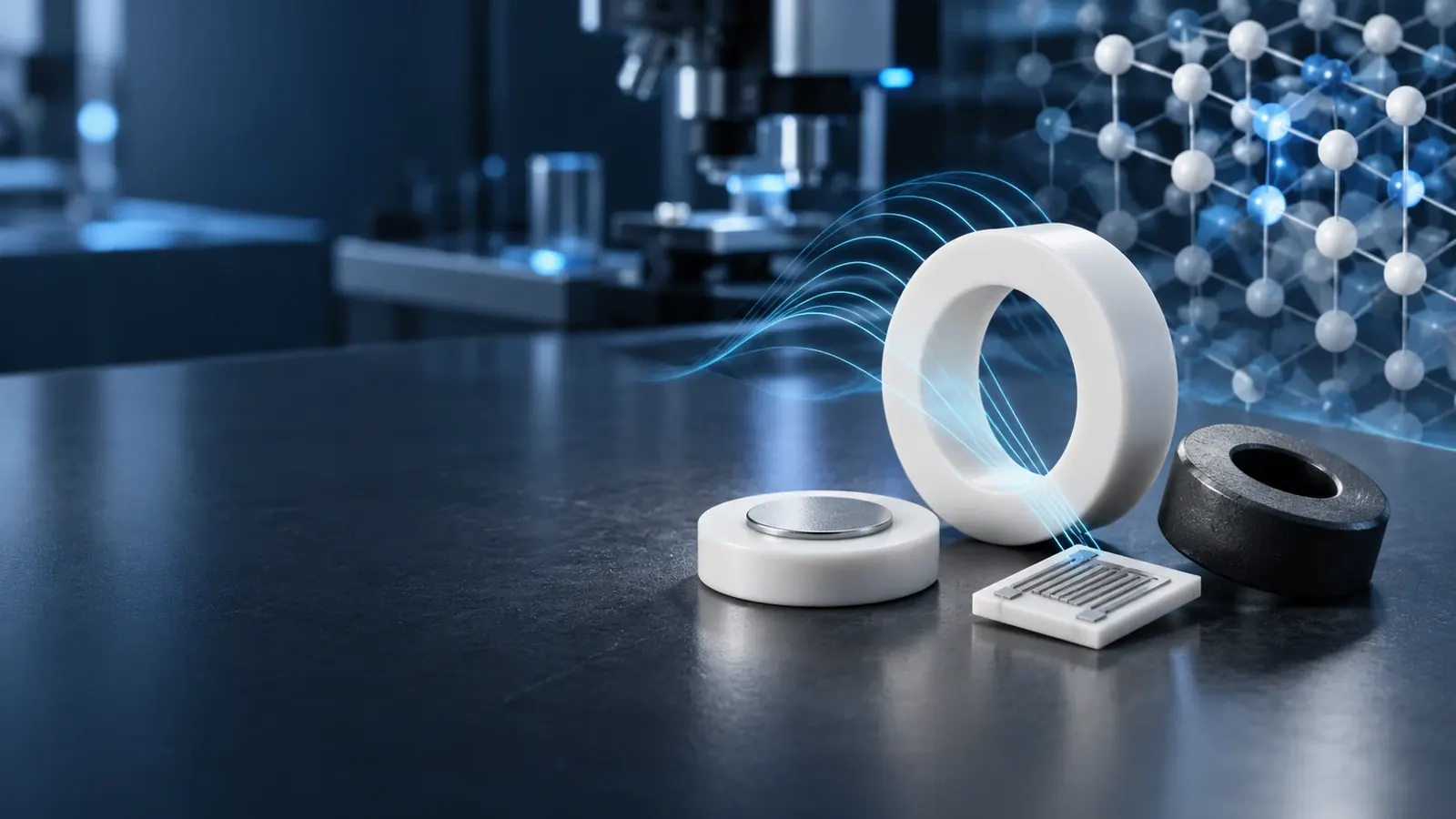
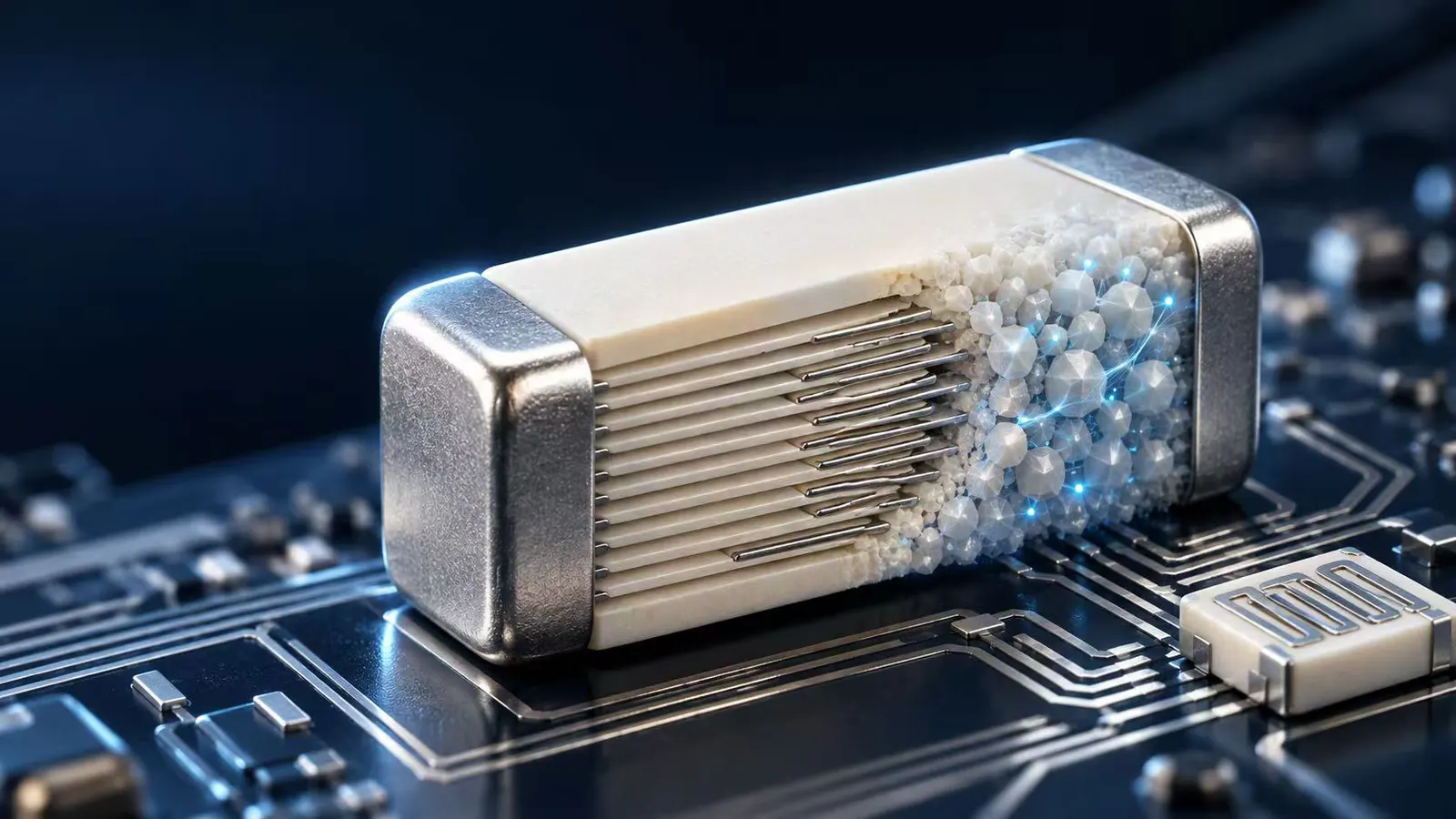
Illustration of a multilayer ceramic capacitor cut away to show internal electrode layers and ceramic grains
Multilayer dielectric ceramics stack thin ceramic layers and internal electrodes into a single component.
02 / Processing

Processing and Integration Technologies

01

High-Purity Powders and Formulation Design

We address raw material purity, particle size distribution, compositional uniformity and agglomeration to develop powder systems suited to defined functional and processing requirements.

02

Precision Forming and Controlled Sintering

We investigate pressing, tape casting and other appropriate forming methods, optimising sintering temperature, atmosphere and heat treatment to control density, grain structure and dimensional change.

03

Thin- and Thick-Film Processing

Research covers coating, screen printing, sputtering and sol–gel processing, with attention to layer thickness, uniformity, adhesion and functional stability.

04

Electrodes, Interfaces and Device Integration

We investigate compatibility between ceramics, electrodes, substrates and packaging materials. Controlling contact resistance, thermal expansion mismatch and interfacial reactions helps translate material properties into device performance.

05

Characterisation and Reliability Assessment

Phase analysis, microscopy, surface characterisation and electrical, magnetic, thermal and optical testing support materials evaluation.

Reliability studies assess performance retention under temperature and humidity cycling, thermal shock, sustained electrical operation and representative service conditions.

03 / Pathway

From Materials Research to Product Application

Development begins with the required function and operating environment, progressing through materials selection, process optimisation, device fabrication and application validation.

  1. 01

    Application Requirements

  2. 02

    Materials Design

  3. 03

    Powder and Sample Preparation

  4. 04

    Performance Validation

  5. 05

    Device Integration

  6. 06

    Pilot-Scale Production

  7. 07

    Application Assessment and Industrialisation

Key development considerations include

  • Functional performance and batch consistency
  • Forming, sintering and machining yields
  • Electrode and packaging compatibility
  • Long-term stability and service life
  • Raw material availability, production energy and overall cost
  • Manufacturing scale-up and quality control
04 / Collaboration

Industrial Collaboration

We welcome collaboration with ceramic powder suppliers, electronic component manufacturers, sensor developers, high-temperature equipment manufacturers and research institutions.

Who we work with
  • Ceramic powder suppliers
  • Electronic component manufacturers
  • Sensor developers
  • High-temperature equipment manufacturers
  • Research institutions
Areas of cooperation
  • Functional ceramic development
  • Formulation and sintering optimisation
  • Thin- and thick-film materials
  • Component integration
  • Pilot production and reliability validation

Contact Us

Translating Functional Ceramic Innovation into Device Applications

Share your target function, operating environment, component geometry and manufacturing requirements with us to explore opportunities for research, validation and industrialisation.